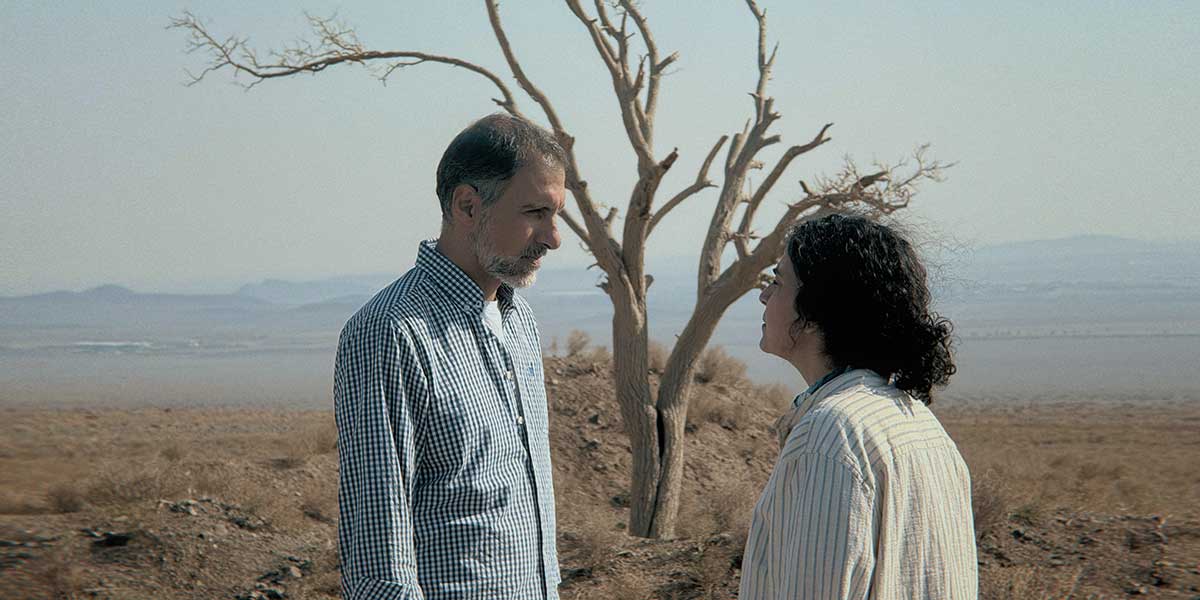
One of the most intense moments in an already-taut, thrilling film comes near the end of it, it being Iranian filmmaker Ghasideh Golmakani’s brilliantly raucous feature debut, satirical black comedy Head to Head. The protagonist Bahar (Mehrnoosh Satari) stolidly refuses to cover her head as a member of the morality police walks closer and closer.
The film, also written by Golmakani, is deliciously meta: a story about a fictional director who takes on cultural misogyny with a satirical film (in which men have taken women’s places), something that Golmakani herself is doing with the film that contains her fictional director.
An internationally acclaimed feminist filmmaker, Bahar is, for all intents and purposes, on the run, with a handful of her cast and crew. Her current project is a satire in which men wear women’s clothes — hijabs, skirts, wrist coverings — and perform everyday tasks. Bahar (and indeed Golmakani) is working within a distinct cultural context: in Iran, motivated and justified by an extremist and misogynistic interpretation of Islam, the government legislation has decreed that women need to cover much, if not all, of their bodies, and must especially cover their heads. The men in Bahar’s film, professional actors, are initially excited about the project and the optics of working with an internationally known filmmaker, aware that association with her might get them positive attention, and even help them in securing a visa to work abroad.
But as the shoot goes on, the actors begin to complain: they’re hot in the clothes, it’s hard to remember to keep wrists covered (because women’s wrists are considered obscene), it’s natural for them to spread their legs wide when they sit, something they cannot do for Bahar’s film. Soon, the police show up — this film is being filmed secretly, for it’s obscene — and Bahar, two actors, and her cameraman hop into a van and drive into a dusty village on the outskirts of Tehran to avoid jail time.
It is on this village’s roads that the band of artists is approached by the morality police, a vice squad that enforces compliance with the strict dress code. Bahar’s colleagues beg her to put something, anything on her head, so that the officer might leave them alone. Bahar refuses, sitting still and fuming. Finally, her cameraman places a scarf precariously over her head, which is enough to deter the police, but not before they utter cruel words at Bahar.
It’s an intense and resoundingly powerful scene, for it depicts a woman standing up for her beliefs despite the immediate threat of violence or incarceration. It would be easy to just put the scarf on, but it would also go against everything that Bahar believes in, and this is what Golkmakani’s film is, at its core, about: the power and strength of women to stand strong in the face of such dire threats.
The project of having men wear women’s clothing is certainly to engender empathy in them for the women around them whom they take for granted, but it’s also and crucially a matter of life, labour, and freedom on one side, and suffocation and death on the other. Bahar wants the men to understand, to see and feel, that it is despite, or in addition to and definitely in response to the misogyny they stand for, these modesty mandates and gender requirements, all this additional gendered labour, that women in Iran also take on the work of activism. It is more labour than most men, the actors included, do, and yet so many women shoulder it, because standing up for each other and for themselves is the crucial act, because freedom is worth it. Once shrugged off, a rebellion that in itself requires a great amount of strength, it is demoralizing, a step backwards from a labour lessened even by a modicum, to espouse a head covering, and everything it stands for, again.
Head to Head is a mighty achievement, and I can’t wait to see what cultural standards Golkmakani decides to examine next.